





THERAPY
COST
373,000 - 500,000 +
Per single infusion
.png?width=50&height=50&name=Failure_v2%20(1).png)
MANUFACTURING
FAILURE RATE
4% - 7%
Estimated range

PATIENT ACCESS /
DEMAND
100,000 +
Batches estimated for the European market over the next decade

DELIVERY /
TIME-TO-VEIN
14 - 28 days
Time that manual sterility testing adds to the entire process
Where advanced therapies meet their manufacturing limit
ATMPs are changing the therapeutic landscape. Their potential is no longer a theoretical promise, but the production model behind them still carries a structural weakness.
Biological science has moved faster than physical manufacturing. Cell therapy processes are still based on manual workflows, highly specialized operators, repeated handling steps and centralized production models.
This creates a gap between what the therapy can do and what the manufacturing system can reliably support.
That gap is becoming harder to ignore: the European market alone is expected to require more than 100,000 therapy batches over the next decade.


From robotic automation to aseptic architecture
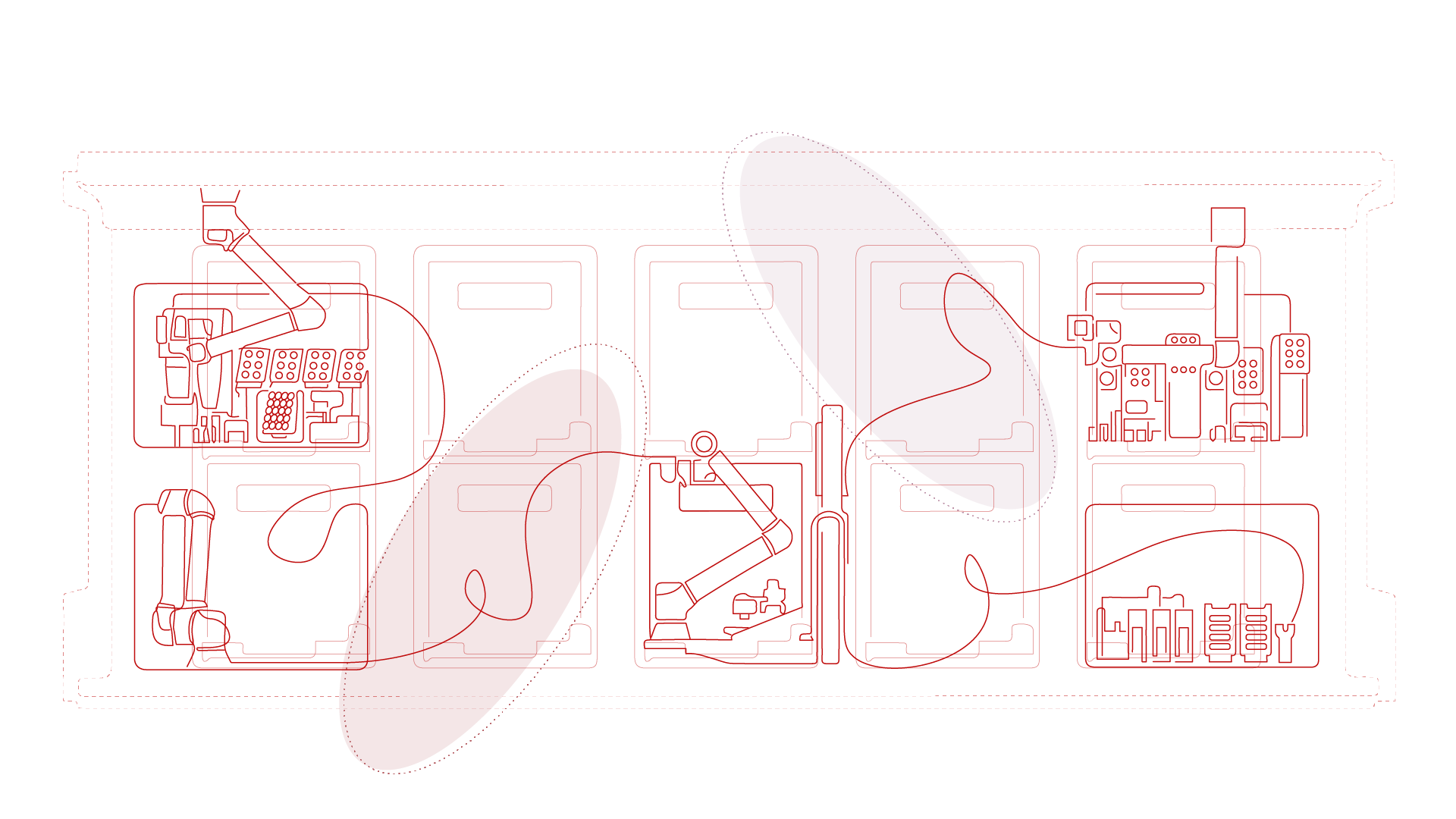
The movement of cells through a robotic cluster is not only a mechanical sequence. Every transfer, every interface and every interaction with the environment can affect the integrity of the process. This is why automation must be framed within an aseptic manufacturing architecture.
Fedegari’s role enters at this level. In the collaboration with Multiply Labs, Fedegari contributes two critical pillars.
The first is the automated sterilization and decontamination module integrated with the robotic cluster. Its purpose is to close the contamination-risk loop around a process where biological material, equipment and environment must remain under control.
The second is the regulatory-compliant manufacturing of the robotic systems themselves. Fedegari supports the production of the systems according to pharmaceutical-grade and GMP expectations, helping transform the robotic cluster into an industrial asset ready for regulated manufacturing environments.
This is not a secondary layer. It is the condition that allows robotics to move from technological capability to pharmaceutical manufacturing readiness. The process comes first. The architecture must follow.
Why manufacturing readiness changes the outcome
The outcome of ATMP industrialization is not automation. It is access.
Published and project validation data indicate up to 74% reduction in manufacturing cost and up to 100x higher throughput per square foot compared with manual processes. They also indicate reduced operator exposure and contamination risk through closed robotic operation combined with automated sterilization and decontamination.
These figures are not only performance indicators. They describe what changes when the manufacturing model becomes less fragile.
Lower cost can reduce one of the strongest barriers to therapy availability. Higher throughput can make production more compatible with the expected demand for therapy batches.
Reduced exposure to manual intervention can support greater consistency and lower contamination risk. More controlled workflows can contribute to reducing the pressure on time-to-vein, one of the most critical constraints for patients waiting for treatment.
In this context, efficiency is not a separate business advantage. It becomes part of patient safety.
Toward decentralized and scalable production
Centralized megafactories have supported the first phase of industrial growth for cell therapies, but they also create distance between the patient and the production line. As demand increases, the next phase points toward more flexible, modular and decentralized models, including point-of-care manufacturing scenarios where production can move closer to hospitals and patients.
This transition cannot happen by reducing control. It can only happen if control is built into the manufacturing architecture.
Modularity, automation, sterilization, decontamination and GMP-compliant system manufacturing become part of the same industrial question: how to make advanced therapies producible in a way that is scalable, reproducible and compatible with pharmaceutical responsibility.
Making advanced therapies manufacturable
ATMPs and CAR-T therapies do not need another promise. They need a manufacturing model capable of carrying their biological complexity without reproducing the fragility of manual production.
The scientific path has been opened. The industrial path must now be governed.
This is where Fedegari’s role becomes strategic: integrating advanced robotic technologies within an aseptic architecture, closing the contamination-risk loop through automated sterilization and decontamination, and supporting the GMP-compliant manufacturing of the systems themselves.
Because in advanced therapies, the future does not depend only on what can be discovered. It depends on what can be produced, protected and delivered with confidence.
When manufacturing becomes ready, breakthrough can move closer to the patient.