




In aseptic manufacturing, the sterile process comes first. To assure the continuity of sterility it is necessary to protect it throughout the whole process, by recognizing that fragility lies not in the connector, but in what crosses it.
When stoppers pass from an RTP port into an isolator the sterile process reaches a non-recoverable boundary. If a single stopper has not been effectively sterilized, the entire batch is at risk: this is the final sterile interface before the isolator.
Under the revised Annex 1, the choice of architecture preceding the RTP interface becomes a critical variable. What matters most is how risk is distributed throughout the process, where fragility accumulates and how sterile continuity is maintained.
Why stopper transfer has become a strategic issue
Stopper transfer is often treated as a mere operational phase between component preparation and filling. Now Annex 1 has clarified expectations around contamination control and sterile transfer and demands stopper transfer to be considered a critical point in the sterile process.
In practice, two structural approaches dominate stoppers management before the isolator:
• RTU gamma-sterilized closures supplied in sleeveless betabags.
• In-house sterilization followed by transfer in a pressurized sterile tan
Both methods are compliant and can be validated. The difference lies in how fragility appears across interfaces, making the choice structural when production scale, risk frequency and lifecycle governance are considered together.

Bag-based or tank-based systems: two different process logics
Sterility is a matter of responsibility: if it is not preserved at this final interface, the entire aseptic process is at risk. Thus the choice between outsourcing or internalizing the sterilization process is a major strategic decision for pharma companies.
The RTU-based system establishes sterility upstream. The facility merely receives sterility and must preserve it. Because these bags typically contain around 1,000 stoppers, this approach becomes structurally fragile as production volumes increase because it multiplies manual interventions. Every additional bag represents another sterile interface and another opportunity for barrier compromise.
As volumes increase, distributed fragility intersects with economics. For production exceeding approximately five million units per year, transitioning from RTU bags to in-house sterilization with tank-based transfer commonly results in a return on investment in the order of 1 year. The choice therefore becomes strategic: reduce interface repetition and internalize sterilization governance.
This is a decision lens, not technological preference.
.png?width=600&height=600&name=Immagine_Stopper_DEM2_600x600_ABM3.0_Fedegari_2026_v1.0%20(1).png)
In response, the industry has converged toward tank-based architectures. Closures are sterilized on site, dried and maintained in a pressurized sterile vessel that connects directly to the isolator. Overpressure provides continuous physical evidence of sterility preservation until RTP coupling. This model concentrates fragility into a single controlled transfer event instead of distributing it across repeated bag connections. Tens of thousands of closures can be supplied through one interface, significantly reducing operational exposure.
While the tank-based segment has historically been shaped by a single consolidated reference, an alternative architecture now exists, derived not from transfer engineering, but from deep sterilization expertise. The decisive difference lies upstream, in how physical principles govern the process before the transfer even occurs.
The physical challenges of stopper treatment
Effective steam sterilization depends on physical conditions that must remain under control across the entire load such as uniform steam contact, controlled condensate removal, homogeneous drying and flawless phase transitions. However, stoppers introduce specific constraints within these conditions: they compress under their own weight, are at risk of coupling at high temperatures, generate particles under friction and can trap condensate in contact areas.
Therefore, stopper treatment cannot be addressed as a simple engineering issue. The difference lies upstream, in how sterilization principles define the process before transfer occurs.
Join the webinar recording
“Stopper treatment: governing closure safety through process design”
April 29, 2026 Online

With Carlo Cattenati – Product Manager, Fedegari
Join the webinar recording to explore how the risk profile drastically changes between bag- based and tank-based stopper treatment systems, and why, with Annex 1, this choice becomes strategic.
Tilting vs rotating: why load movement changes the sterilization process
Once sterilization cycle is analyzed through process principles, a second level of complexity emerges: how the load behaves during treatment. This is where the comparison between tilting and rotating tanks becomes critical.
Movement is not just a mechanical feature, it dictates the physical conditions the process must govern.

Traditional tilting architectures load closures in the same vessel used for connection to the filling line. Heating, sterilization and drying occur within this container, with movement induced by a ±120° oscillation.
This motion forces closures to move collectively as a single mass, compressing the load under its own weight while drainage is primarily bottom-oriented. Ultimately, the transfer container defines the sterilization boundary.
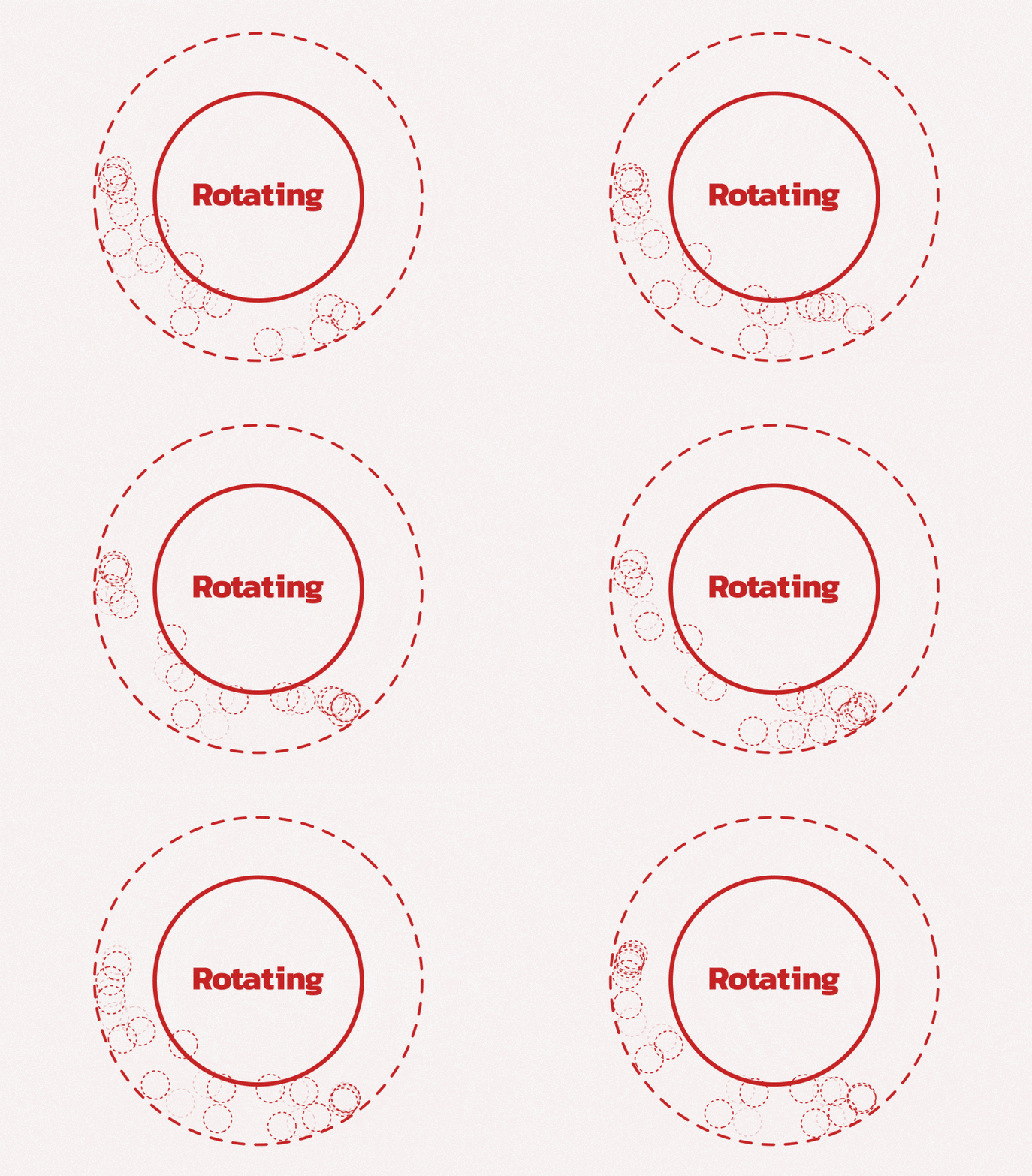
Our alternative to tilting is a rotating drum where closures are loaded into a perforated drum positioned inside a dedicated autoclave chamber, where washing, sterilization, drying and cooling occur in a fully controlled environment. The load is continuously tumbled rather than forced to move as a compressed mass. Condensate removal is enhanced by continuous reorientation and once the cycle is complete, a reverse rotation gently unloads the sterile closures into a separate tank dedicated exclusively to transfer.
When the load itself influences steam contact, condensate, and particles, complexity becomes structural. In Fedegari’s architecture, system design originates from the deep understanding of sterilization principles rather than transfer engineering.
The beneficial outcomes of a fully governed process
Once the system architecture is aligned with sterilization physics, the industrial benefits become structural consequences of the process design. This translates directly into two crucial advantages:
• Upstream sterilization control: sterilization alone cannot correct a high particulate or endotoxin load; it only inactivates defined microbial populations. Integrating a complete washing phase prior to sterilization directly in the same solution without additional equipments allows contamination to be addressed at its origin within the same architectural logic, ensuring a continuous and unfragmented process.
• Thermodynamic efficiency: the optimized environment generated by a well-designed process inherently decreases cycle variability. As a result, utility consumption is approximately 30% lower than in conventional tank-based systems. Even if energy efficiency is not the primary objective, it is the consequence of governing sterilization physics correctly.