




The next phase of EtO replacement will not be won by technology selection alone. It will be won by those capable of industrializing complex sterilization processes. In a previous article, “Reshaping the future of sterilization”, we explored the progressive shift from Ethylene Oxide EtO sterilization toward alternative sterilization technologies, with particular focus on the rise of vaporized hydrogen peroxide as a credible pathway for medical device sterilization.
That discussion was about transition. This one looks at complexity: the factor that determines whether this sterilization modality can be translated into a validated industrial process.
Because the challenge is no longer only identifying an alternative to EtO. It is understanding how sterilization processes behave when they interact with sensitive materials, intricate geometries, multilayer packaging and configurations that cannot be reduced to a standard condition.
Moving beyond EtO shifts the focus from technology selection to process governance.
The challenge is not selecting a sterilant, but it is governing how that sterilant behaves across complex devices.
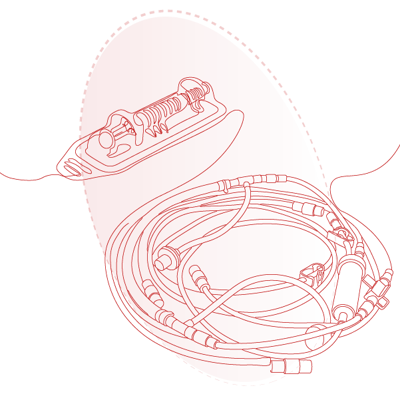
Complexity is not an exception. It is the starting point.
In medical device sterilization, complexity begins when sterilization processes must interact with real product configurations.
• Multilayer packaging can limit sterilant diffusion and create gradients that affect both penetration and residual removal.
• Long lumens and non-vented geometries introduce constraints that make sterilant distribution dependent on process dynamics, not only on accessibility.
• Multi-material assemblies can respond differently to the same process conditions, influencing both sterilization efficacy and product integrity.
This is why sterilization performance cannot be considered a property of the sterilant alone. It is determined by how the process is developed, tested and controlled under specific application conditions. From syringes to oxygenators, from multilayer packaging to long lumen systems, sterilization challenges differ.
But the process must always be governed.


Discover
Understanding how materials, geometries and packaging configurations affect sterilization feasibility.

Learn
Experimentally evaluating sterilant diffusion, residual behaviour and worst-case conditions to understand how the process behaves under real constraints.

Innovate
Developing tailored process parameters and cycle configurations based on the interaction between sterilant, device and packaging.

Impact
Achieving validated sterilization processes transferred to industrial conditions, ensuring:
• sterility assurance level up to 10⁻⁶ / 12 log reduction;
• controlled residual levels;
• reduced cycle times;
• elimination of post-process storage, where applicable according to the process configuration.
This is where process knowledge becomes industrial value.
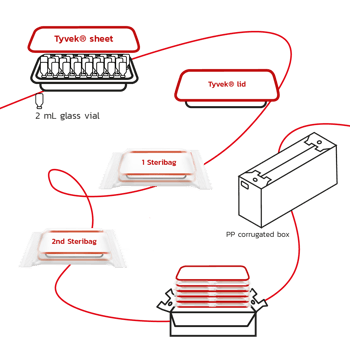
Where Technology Centers turn process development into industrial deployment
Fedegari Technology Centers are not only testing environments, they are the bridge between scientific development and industrial execution: the point where process assumptions are challenged, measurable evidence is generated and sterilization cycles are developed before reaching production.
Within these environments, process complexity can be reproduced, observed and measured. Worst-case configurations can be evaluated to understand how sterilant distribution, material interaction and residual behaviour affect performance.
Process conditions across industrial applications
The following applications are not product examples. They represent sterilization process conditions across different levels of complexity, device classes, materials and packaging configurations.
Each configuration reflects a specific interaction between sterilant, materials and geometry, requiring dedicated process conditions.
| APPLICATION | CLASS / DESCRIPTION | MATERIALS |
|---|---|---|
 Empty syringe Empty syringe |
MD, Class IIa | PP, LDPE, PI, Medical-grade paper, PA/PE film |
 Vitrectomy system Vitrectomy system |
MD, Class III | PC, Tyvek®, PP |
 Suture Kit Suture Kit |
MD, Class IIb | PA, Tyvek®, PET |
 PFS with ophthalmic drug PFS with ophthalmic drug |
Combination Product | Glass, PI, Tyvek® |
 RTU vials RTU vials |
Primary container – MD Class IIa | Glass, Tyvek®/LDPE |
 Pacemaker Pacemaker |
MD, Class III | Various materials |
 Filter Filter |
Single Use Technology | PES, PSU, PP, PU, PC |
 Hemodialysis Tubing set Hemodialysis Tubing set |
MD, Class IIb | PVC, PP, Medical Paper/LDPE |
 Oxygenator Oxygenator |
MD, Class III | PU, PET, PVC, PC, Tyvek®/LDPE |
These applications include different device classes, materials and packaging conditions, from empty syringes and vitrectomy systems to hemodialysis tubing sets and oxygenators.
Join the webinar recording
“Beyond Eto: mastering sterilization complexity in real medical device applications”

With Claudio Maestri, Product Manager Fedegari and Lucia Maita, Training & Process Development Expert Fedegari
The industry is moving past Ethylene Oxide. But how do you make safer alternatives actually work when they meet real-world medical devices?
Join the webinar recording to explore how a process-driven approach is the key to engineering the transition to safer processes for your medical devices.
Behind each application lies a specific sterilization challenge
The case study on combination products sterilization shows how vH₂O₂ was investigated on glass prefilled syringes containing an ophthalmic drug product, enclosed within Tyvek®/plastic blister packaging.
The investigation focused on:
• material compatibility;
• penetration efficiency through secondary packaging;
• sterilization process effectiveness;
• H₂O₂ residues in the product and secondary packaging.
The device defines the challenge. The process defines the answer.
Download the full case studies to discover how these challenges are addressed through controlled process development.
When the process is governed, industrial execution becomes reproducible
The applications presented throughout this article show how complexity changes the way sterilization processes must be developed, verified and transferred to production.
Only under these conditions, the ability to experimentally develop and industrialize sterilization processes becomes the determining factor in achieving reliable and reproducible performance.